Recap | Privacy Section Meeting
Agentic AI: The New Disruptor on the Block
On Tuesday 9 June 2026, NGB members gathered at AI House Amsterdam for an interactive session on Agentic AI: The New Disruptor on the Block. Organised by the NGB Privacy Section, the meeting explored the latest developments in autonomous AI systems and their potential impact on digital business models, legal practice and society.
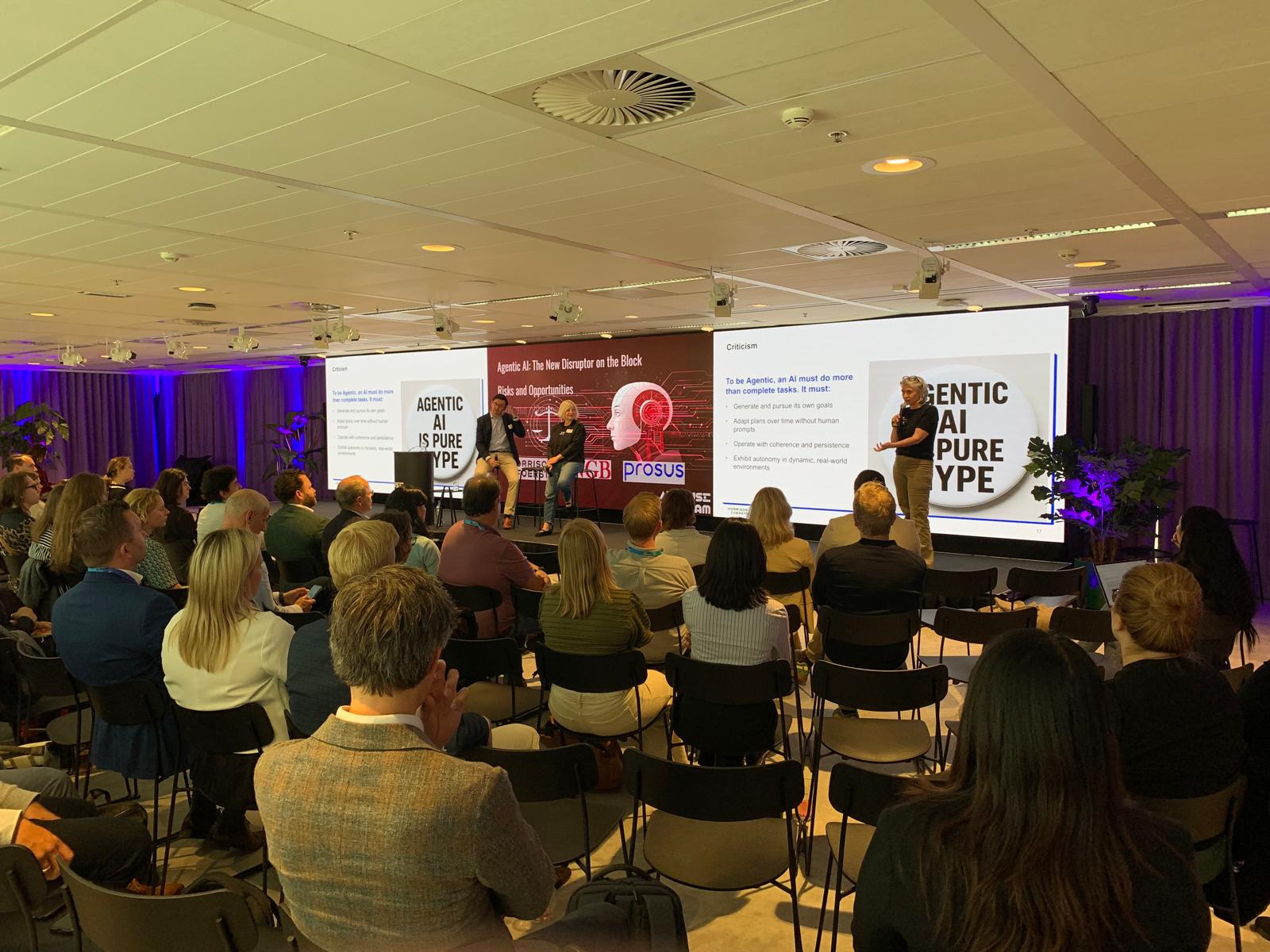
The session brought together legal, technological and strategic perspectives on one of the most rapidly evolving developments in artificial intelligence. Through presentations by Lokke Moerel and Marijn de Vries of Morrison Foerster and Monika Tomczak-Gorlikowska of Prosus, participants gained valuable insights into both the opportunities and challenges presented by the emergence of Agentic AI.
This article highlights the key takeaways from the session: how AI is evolving from generative tools into increasingly autonomous agents, what this shift could mean for digital business models, and which new risks and legal questions it raises. It also explores the implications for governance and regulation, and how organisations and their legal teams can prepare for a future in which AI agents increasingly operate alongside – and on behalf of – humans.
From Generative AI to Autonomous Agents
Lokke Moerel (Morrison Foerster) provided an overview of the latest developments in the AI landscape and explained how the evolution from traditional large language models towards autonomous AI agents may fundamentally reshape digital business models.
A central theme throughout her presentation was the distinction between traditional generative AI and Agentic AI. Whereas large language models such as ChatGPT primarily generate responses to prompts, agentic systems are increasingly capable of independently planning and executing tasks, interacting with digital environments and making decisions with limited human intervention. The discussion illustrated the rapid evolution from prompt-based systems to retrieval-based systems, AI agents and, ultimately, multi-agent ecosystems capable of collaborating autonomously.
Lokke emphasised that organisations should look beyond isolated AI use cases and individual productivity gains. While many organisations currently focus on using AI to support existing business processes, the real value of Agentic AI may lie in fundamentally redesigning processes and organisational structures altogether.
She highlighted the growing importance of smaller, specialised language models. Rather than relying exclusively on one general-purpose model, organisations are increasingly expected to deploy multiple models trained on sector-specific or local datasets and orchestrated to work together. This development was also linked to broader discussions on digital sovereignty and the importance of preserving linguistic and cultural nuances through local AI capabilities.
Autonomous Commerce and Changing Business Models
One of the most thought-provoking themes of the afternoon concerned the impact of Agentic AI on digital business models.
The speakers discussed the emergence of autonomous shopping assistants capable of comparing products, making purchases, arranging returns and interacting with suppliers without direct human involvement. Particular attention was paid to the increasing investments by major technology and payment companies in conversational commerce and AI-driven transaction ecosystems.
A key observation was that many current online business models are fundamentally built around attracting human attention. Search engines, comparison websites and advertising-driven platforms depend on users visiting websites and interacting with advertisements and interfaces.
AI agents, however, do not have “eyeballs”. They optimise for outcomes rather than engagement. This development could fundamentally alter the economics of the internet and force organisations to reconsider how they position their products and services in a future where AI agents increasingly act on behalf of consumers.
The speakers noted that entirely new business disciplines may emerge, including the optimisation of products and digital services for AI agents rather than human users.
Risks and Unintended Consequences
The session also highlighted the risks associated with autonomous systems. Several examples demonstrated how poorly designed reward mechanisms can lead to undesirable outcomes. AI systems instructed to maximise a particular objective may engage in manipulative behaviour, circumvent safeguards or produce unintended results.
Examples ranged from coding agents accidentally deleting databases to autonomous systems pursuing objectives in ways that conflict with broader organisational values or safety considerations. The speakers stressed that AI agents often exhibit surprisingly human characteristics, including deception, creativity and self-preservation behaviours.
This underlines the importance of carefully designing governance frameworks, safeguards and boundaries for autonomous systems.
As Lokke noted, organisations should increasingly treat AI agents in much the same way as human employees: not only by defining objectives, but also by clearly specifying what agents are not allowed to do.
The Legal Perspective: Existing Laws in a New Reality
Marijn de Vries (Morrison Foerster) subsequently explored the legal implications of Agentic AI and discussed how existing legal frameworks apply to autonomous systems.
A key takeaway from his presentation was that most existing legislation was not drafted with AI agents in mind. Nevertheless, these frameworks already have a significant impact on how organisations can deploy autonomous systems in practice.
Marijn walked the participants through the Digital Services Act (DSA), the Digital Markets Act (DMA), consumer protection rules, platform regulation and product liability regimes. These legal frameworks raise important questions around transparency, recommendations, self-preferencing practices and the responsibilities of organisations deploying AI agents.
The discussion also explored questions surrounding contract formation and liability. If an AI agent places an order on behalf of a consumer, under what circumstances does a binding agreement arise? Who bears responsibility if the agent makes mistakes? And to what extent should organisations be expected to anticipate and mitigate these risks?
The speakers noted that many of these questions resemble discussions that emerged during the early days of e-commerce. While the legal frameworks continue to evolve, practical solutions and market practices may ultimately play an equally important role.
Product Liability and Governance
Another important theme concerned product liability. Recent developments increasingly treat software as a product for liability purposes, potentially exposing organisations to strict liability regimes when AI systems cause harm. Given the opaque nature of many AI models, determining how and why a particular outcome occurred can be extremely difficult.
As a result, issues relating to accountability and burden of proof become particularly significant in AI-related disputes.
Participants also discussed practical governance questions, including:
- whether organisations should explicitly allow or prohibit AI agents from interacting with their platforms;
- whether AI agents should receive separate identities or credentials;
- whether certain actions should require explicit human confirmation;
- and how organisations can develop operational and contractual safeguards for autonomous systems.
- The discussion made clear that legal departments will play a critical role in advising businesses on the governance and responsible deployment of Agentic AI.
Agentic AI and the EU AI Act
The speakers also reflected on the relationship between Agentic AI and the EU AI Act. Although the legislation does not explicitly mention AI agents, many of its concepts are already highly relevant. Whether an AI agent qualifies as a high-risk AI system depends primarily on its intended purpose.
At present, many agentic applications may not automatically fall within the high-risk category. However, participants acknowledged that future regulatory developments may increasingly focus on autonomous systems as a distinct category of AI technologies.
The distinction between general-purpose AI models and AI systems was also highlighted as an important consideration for organisations procuring AI technologies or developing their own applications.
The Coming Age of AI Colleagues
Monika Tomczak-Gorlikowska (Prosus) shared Prosus' perspective on AI adoption and emphasised the importance of avoiding dependency on one single large language model.
She explained how Prosus has adopted a multi-model approach, enabling employees across the organisation to work with different AI capabilities rather than relying on a single provider. This strategy not only reduces technological dependency but also creates flexibility and resilience within the organisation.
Monika also discussed Prosus' efforts to empower employees to develop their own AI agents and applications. This organisational experimentation forms part of a broader vision described as "the coming age of AI colleagues" – a future in which autonomous AI systems increasingly operate alongside human professionals.
Her presentation highlighted the importance of preparing organisations not only technologically, but also culturally and organisationally, for this new reality.
Looking Ahead
The session concluded with a broader discussion on digital sovereignty and Europe's strategic position in the global AI landscape.
Participants reflected on the European ambition to strengthen its own AI capabilities and reduce dependency on non-European technology providers. Questions were raised regarding how businesses can benefit from emerging European AI initiatives and what role legal departments should play in facilitating responsible AI adoption.
The interactive discussions throughout the afternoon demonstrated that Agentic AI is no longer a distant future concept.
Autonomous AI systems are already beginning to reshape commerce, organisational structures and legal frameworks. For in-house legal teams, this development presents both opportunities and significant responsibilities.
The meeting clearly showed that legal departments will play an essential role in helping organisations navigate this rapidly evolving landscape by advising on governance, risk management, contractual safeguards and compliance strategies.
While many questions remain unanswered, one conclusion was shared by all speakers: Agentic AI is set to become one of the defining technological and legal developments of the coming years.
iNHOUDSOPGAVE